
TenduTV is a digital network that delivers dance programming to over 500 million screens in 10 countries including televisions, tablets and mobile devices. Previous to our involvement, TenduTV did not have a system for displaying or managing their catalogue online. We created custom post types to allow them to build a nascent IMDB-like system, listing out all their films via a manageable system.
aCanaryTorsi
We worked very closely with Yanira Castro (the artisitic director and founder of acanarytorsi) to develop a completely custom identity for her company and website. To create the background video for her website, we directed a full video shoot. We also designed multiple versions of the site before finalizing the current design.
In addition to using a custom CMS for the flash front-end, we also integrated Slideshow Pro to manage the galleries, and WordPress to manage the blog.
This project was listed as one of Slideshow Pro’s Top Ten Websites.
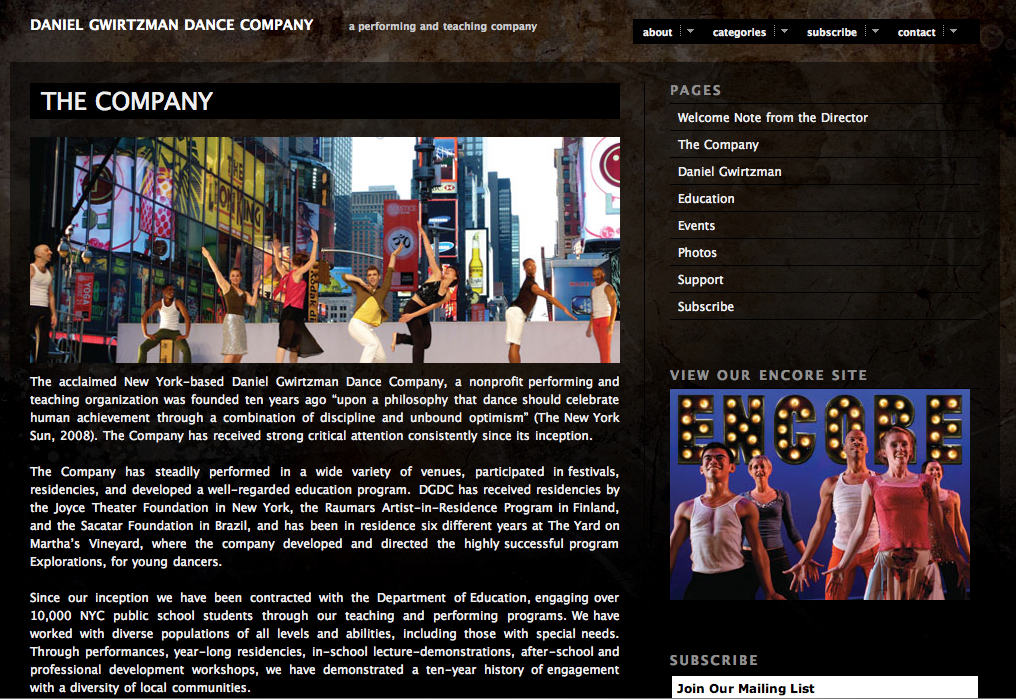
Daniel Gwirtzman Dance
Daniel Gwirtzman faced a very familiar problem – he had a good looking website, but it had not been updated in years. So we took all his content and created a WordPress site. As a result of our work, pageviews increased dramatically as did time spent on his site (close to a 600% increase!).
And yes – he still updates his site regularly.
DanceBrazil
Jelon Vieira, the artistic director of DanceBarzil, is arguably one of the most influential figures in the world of Capoeira.
When we started working with DanceBrazil, they had virtually no web presence. So we developed their website, setup a facebook page, created a flickr account, and launched a vimeo page. At the end of their inaugural season with us, we also produced a live webcast (in English and Portuguese), streaming their performance across the globe.
Our efforts paid off very well – for every $1 they spent on us, we managed to bring $8 back for a total 1:8 ROI. And most interestingly, viewers from Brazil could finally take in their artistry.
Live Performance on the Web, Saturday 7pm
Please join us tonight for this very special event. We’ll be streaming this dance performance live on the web and feature a live webchat.
Misnomer Dance Theater
Live from Symphony Space, April 3rd | Saturday at 7pm
Premiering Cellophane, Misnomer’s newest piece – watch the rebroadcast here :
Read More…
Producing Live Webcasts
OVERVIEW
Over the past year, I’ve produced a few webcasts for dance companies. I recently wrote an article about these webcasts, asking questions – mainly – is it worth it?
For this article, I’ve included a few insights and considerations for producing your own webcast.
The examples I will look at include Misnomer’s webcast in December, DanceBrazil’s webcast in March, and another Misnomer webcast in April. Two of these webcasts were done in conjunction with a season, whereas Misnomer’s performance in April was a work in progress showing.
All of these webcasts were done with a few goals in mind.
1. Diversify Audiences (Build New a Audience, online)
2. Expose current audience members and their friends to the work and company (Broaden our reach)
3. Give audience members who already saw the work (Deepen the experience of existing audience members)
Additionally, it was quite important to consider these webcasts as a web event. These webcasts were successful because they were conceived as a web specific piece. Online audience members were excited to chat with each other and experienced a unique event. In preparation for all events, I prepared online media (photos, blog entries, interviews, slideshows). While preparing these materials, I was conceiving a unique online experience. I thought, “What would hyperlinked program notes look like?” and went about publishing and sharing those materials online.
TECHNOLOGY
The technology required was not too complex. For the Misnomer webcasts, I signed up for an account on UStream.tv. For DanceBrazil’s webcast, I partnered with Dance-Tech.net, and used Mogulus (now LiveStream). LiveStrea and UStream.tv are currently very popular solutions for producing a webcast. Both services offer many broadcasting options, including overlays, pre-roll video, and even a webchat. All of these options were great additions to the webcast. However, the webchat proved to be one of the more engaging experiences. While you are doing your webcast, you can also record video, and archive it. This webcast can also be rebroadcast and embedded on other sites and blogs if you wish. In short, it’s like YouTube, but live.
To produce a good webcast, you will need to ensure your video quality is optimal. Invest in a good camera person, and practice. Just like you would do a tech rehearsal for your stage performance, you should do a tech rehearsal for your webcast. You will be connecting your video signal from your camera (or video mixer) to a computer, so you need to make sure the video looks excellent. You should also ensure your internet connection is optimal. I would not recommend doing a webcast with a wifi connection. To ensure the best quality and the highest speed, make sure your laptop or computer is connected to the web via an ethernet cable.
In addition to a videographer, you should also secure at least one solid person to handle all things online. While the videographer is focused on the image quality and overall video shoot, the online moderator will be focused on the web experience, webchat, and quality of the streaming experience.
After you secure your team (and good internet connection), you will simply connect the video signal to your laptop or computer. UStream.tv + LiveStream both have a fairly straight forward interface. As long as you have your video signal connected to your computer (via firewire), and you are signed into your UStream or LiveStream account you can start broadcasting. Like a good videographer, it is imperative you have someone onsite to monitor the online experience, moderate the webchat, and ensure the web experience is optimal.
SURPRISES
The webcast did not take away from ticket sales. I was chatting live with all the online, I did not encounter any online viewers who opted to see the work online instead of in the theater. Many people who were watching the webcast had already seen the work. Also, some viewers of the webcast were not able to see the work, so this was a nice replacement for them.
There were also many viewers from different countries. All three webcasts were produced from New York City. However, we had visitors from over 19 countries including Brazil, Turkey, Israel, Spain, England, Canada, and Germany. For Misnomer’s webcast in December, we had over 1200 viewers. This means that Misnomer had more viewers – online – in 1 night than they had during the entire run during the New York Season.
Another surprise – more people came to the websites after the webcasts. I archived all 3 webcasts online, and offered viewers a chance to see it again. Since many viewers were not able to make the performance or live webcast, they came to see the video after the fact. With DanceBrazil, more people visited DanceBrazil.org the day after the webcast than any other day of the year. Additionally, many people subscribed to DanceBrazil’s email newsletter as a result of the webcast.
Simply stated, the webcasts provided a great experience for current fans and audience members. They were able to connect with the company in a new way, and on their own time. For many new fans, the webcasts gave them a unique way to experience dance, and ask questions. Several viewers had never seen the company’s work live, and this was their first encounter with the work. On the other hand, some people found the video quality inferior, and did not like watching the performance online.
As video quality continues to improve, and audiences continue to diversify, performing arts organizations will have to diversify their methods of presentation. Providing a high quality experience online and in the theater are equally challenging and essential. Producing a webcast for your audiences is a great way to reach new audience members across the globe, and deepen your current audience’s experience online.
SUMMARY
1. Test. Test. And Test. For all webcasts, we did a few tests.
2. Hiring a good camera person is essential.
3. Testing is also critical. Just like you would tech a show before premiering, do a few tech rehearsals with your streaming gear.
4. Make sure your venue has a fast Internet connection. Don’t use wifi to stream.
5. A webcast is markedly different from a stage performance.
6. Prepare online content for your online viewers
7. Make sure you have an online chat moderator who understands the company and the work.
And finally…
Feel free to contact me with any questions.
RELATED LINKS
Article 19 did a nice overview of Misnomer’s webcast in December.
You can take a look at the article here:
http://www.article19.co.uk/06/written_feature/live_on_the_internet.php
Misnomer’s Webcasts can be found here:
http://misnomer.org/live
DanceBrazil’s Webcasts can be found here:
http://dancebrazil.org/
Live Webcasts for Arts Organizations
One of the more exciting developments this past year (aside Obama’s Inauguration, the stock market crash, and Twitter – yes there are other things in this world aside from twitter), has been the proliferation of live online video.
Websites + companies like UStream.tv and Mogulus have made high quality live web broadcasts a reality.
This past year alone, I produced live performance webcasts for Martha Graham Dance, Misnomer Dance, and DanceBrazil. All of these webcasts featured live webchats, and a global audience.
These unique online events brought in more audience members than the theaters could hold, and generated more online buzz than any of these companies could have hoped for.
Simply said, more people saw their work online than in the theater. Not only that, but the online audience loved the performances and were highly engaged, updating their facebook statuses while the performances were happening. Many came back to the website long after the webcast was done to see the archived video. All of this was not too surprising for me. People love interacting online, particularly around live events.
Just think back to the past few Oscar Parties, Superbowls, and Elections….
What was surprising to me – many people who were watching the webcast had already seen the company’s work before live – in the theater. However, countless others had never had the opportunity to see the company’s work and lived in places the company had not yet toured.
I thought I’d share a little more insight and answer some common questions I’ve received since then:
- How do I do a live webcast?
- How much does this cost?
- Is this for me?
- Where’s the money?
- Will it take away from my live audience?
Before I start answering these questions, I’m wondering – why aren’t more companies doing this?
Bars in New Orleans and Fort Lauderdale have webcams and webstreams.
Why aren’t arts organizations and companies doing the same?
I’m convinced this is the year companies will start putting their live work on the web.
Am I wrong?
LINKS:
Watch Misnomer Dance‘s webcast
Watch DanceBrazil‘s archived performance
Dance Videos made for the web
Why is “dance made for the web” an important topic?
Elizabeth Zimmer wrote in December 2008, “The past 20 years have seen the proliferation of cheap video equipment, and rare is the downtown stage not shared between dancers and video projections…some of these artists are as savvy as they are gifted, and they will figure out a way to cross over and enter the consciousness of a critical mass of viewers.”
As audiences for dance grow through the web and stage, so does the opportunity to create and share work.
Some it is completely choreographed, others are more improvisational.
I’ve compiled a few videos that give us a peek into the present + future (or death) of dance, art, technology, and the surrounding community dialogue on the web. Please feel free to add links to videos you’ve seen in the comments section.
Also – for a nice overview of videos focused on Ballet, take a look at Doug Fox’s post.
http://dancetech.ning.com/profiles/blogs/dance-tech-episode-1
I will be showing + starting at 12:13
Maybe we all dream to be………? from T.A.G.San Francisco on Vimeo
Dancers: Drew Jacoby and Rubi Pronk
Choreography/art direction: Brian Gibbs
Shot and edited: Mattew Taylor
The piece was shot on a rooftop in Williamsburg Brooklyn
There are many more videos available “below the fold” –
See the full post
Click the MORE link to see the rest of the videos…
Artist Salon at Chez Bushwick, March 25th
[via Move The Frame blog]
At the next Artist Salon on March 25th at Chez Bushwick, I will be looking at dance work created specifically for the web. Dance on Camera has already established itself as a viable medium for showcasing dance + performance. However, there is a growing trend of artists creating and adapting work specifically for the web. For example, New York City Ballet’s Tragic Love series, or more recently, Cedar Lake’s Project 52 – all videos made specifically for the web.
Like site specific work, these (web)site specific pieces are showing that these new constraints are creating short format work, with new possibilities for distribution, creativity, and collaboration.
You are invited bring in your own examples of web-based videos to show at the Salon.Â
The Artist Salon series happens on the fourth Wednesdays of the month at Chez Bushwick and features dialogue across disciplines around various artist-chosen topics. Anyone can bring questions, stories, artifacts, or material to add to the conversation.
ARTIST SALON
“Dance for Web†moderated by Jaki Levy
Wed. March 25, 2009 @ 7pm $5
Chez Bushwick 304 Boerum St., Buzzer #11Brooklyn, NY 11206
718.418.4405
Directions
•L TRAIN to Morgan Avenue •Exit the BACK of the train •Turn LEFT outside the station •Turn LEFT onto Boerum Street (Chez Bushwick is roughly 80 steps from the station)
Google Map
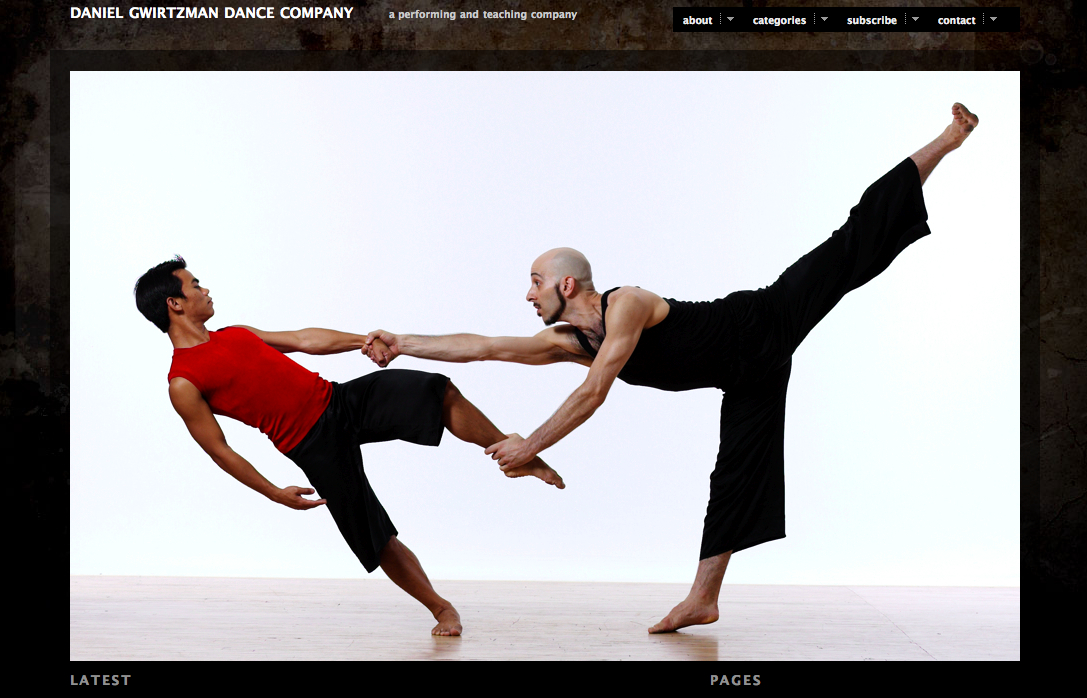
We’ve launched Daniel Gwirtzman’s site!
I’m happy to say we’ve officially launched Daniel Gwirtzman Dance Company’s new site!
Actually, I’m quite impressed with the final product we put together for the Daniel Gwirtzman Dance Company. With the help of great media all around, we were able to piece together a photo gallery, a video gallery, a new subscription system, and even an SMS delivery system for his audiences.
It’s really been great working with Daniel and his company. They really did a phenomenal job in gathering their assets, organizing their content, and creating compelling videos. Congratulations, Daniel! It’s exciting to know I’ll be able to continue to help you communicate your wonderful work!
If you like this, take a look at my other work.
[screenshots follow]
About Page | Features: Large Image on each page, drop-down navigation, links to video gallery, customizable sidebar navigation
Home Page | Features: Slide show, customizable footer area, drop-down navigation bar
While launching the site, I found this guide to be particularly useful:
http://codex.wordpress.org/Giving_WordPress_Its_Own_Directory
I initially setup this wordpress site in a subdirectory ( /wordpress ) so that I could develop things without affecting their active site. After the wordpress site was all setup, I needed to make the switch. The article above did the trick for me.
I’d love to hear your thoughts – share your ideas and leave a comment!
New Site Launch | Time Lapse Dance
With the help of many, many people and some great teamwork, we officially launched this site for Jody Sperling : Time Lapse Dance
The original redesign was put together by Paris Marashi, while the site design and content management system was executed by Sam Marx
Jody’s upcoming work, Ghosts, will feature a wearable costume assembled by ITP folk (Jenny Chowdhury & Alex Kowal)
The site features a full content management system (run on Drupal), a full media player managed through brightcove, and some nice graphic work provided by her colleagues.
Check out the customized media player here.
During the process, we spent great care taking a look at the works page.
We wanted to make sure we could feature individual photos, videos, and text – all in one area – so the content management system had to be flexible enough to handle all those elements.
During the process, we also setup a facebook page, a blip.tv page, as well as a pro flickr account. The goal of setting up all these sites were simply to allow Jody to extend her reach beyond her site, while still providing a homebase for her work, and image.
In addition to visiting the new site, make sure you check out Ghosts, premiering in October!
Dance/USA Winter Conference | Broadening, Deepening, Diversifying
This weekend, Chris Elam, Kristin Sloan, and myself are at Dance/USA’s Winter Forum. Together, we’re leading a workshop for dance organizations, helping them develop strategies for video.Â
Broadening entails reaching new audience members who are similar to your current audience.
Diversifying means developing an entirely new base.